How often should you clear the gutters on a Cotswold cottage?
I get asked this a lot, and I think most people want permission to leave the gutters for another year. I'll be honest with you. You can't. Not round here.
Twice a year is the minimum for a Cotswold cottage. Late spring after the blossom and early leaf drop. Early winter after the autumn properly commits to falling off. If you've got a big sycamore or lime overhanging the roof, add a third clear in late summer too.
Why Cotswold cottages need it more than most
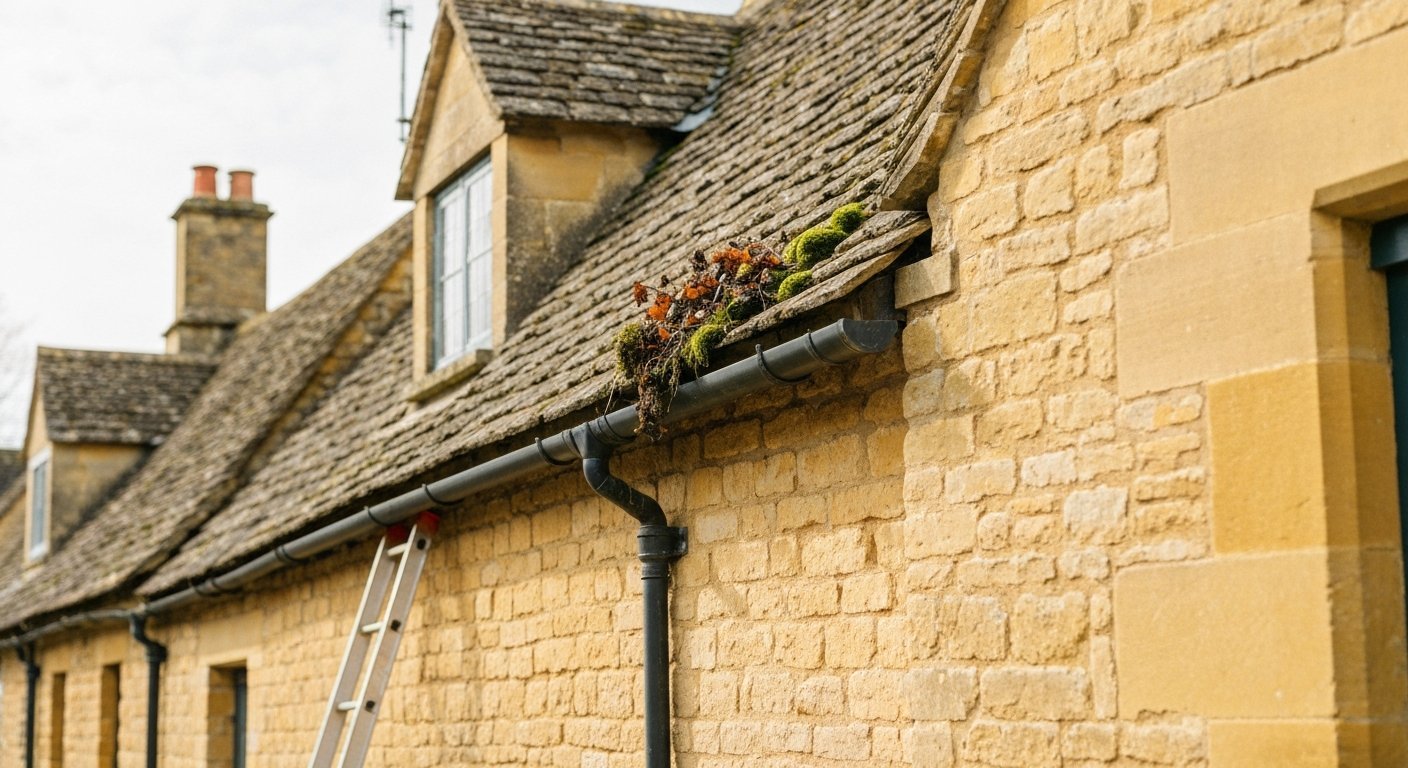
Three reasons. First, a lot of the roofs round here are stone or tile, not modern concrete, and the grit comes off them every winter in little pieces that wash down into the gutters. Over a few years you can get a proper layer of roofing debris sitting in there.
Second, moss. It loves the north-facing slopes and it loves the damp, slow-moving water in a blocked gutter. Moss in a gutter is a dam. Water backs up behind the dam. Water behind a dam on a stone house finds the nearest weak point in the pointing and heads inside.
Third, jackdaws. The local jackdaw population is enthusiastic about nest-building, and a chimney pot with a loose cowl is a magnet. Twigs drop off into the gutter. A gutter full of twigs doesn't drain.
What a blocked gutter costs you
If you're reading this thinking "I'll leave it until summer", consider what's actually happening in there. Water that can't flow over the lip and down the downpipe has to go somewhere. So it goes:
- Back up under the tiles, which rots the fascia and the ends of the rafters. A new fascia and soffit run starts at around £800 plus materials.
- Down the face of the wall, which saturates the pointing and, eventually, the plaster inside. New plaster is not cheap.
- Into the cavity, if you've got one. This is the really expensive one. Cavity wall insulation holding water is a proper headache.
- Into your neighbour's gutter if you're terraced. Which is a great way to fall out with the people next door.
Meanwhile a gutter clear, done properly, is usually less than £100 for a semi-detached house in Cirencester. I've made that pitch to myself many times up a ladder in November weather.
Warning signs you've left it too long
Even if you're not the gutter-checking type, watch for these:
- Plants growing out of the gutter. Yes, really. I've pulled out ash saplings that were a foot tall.
- A dark streak on the wall below the gutter joints, which is water getting out where it shouldn't.
- Water dripping mid-run during a downpour rather than flowing off the downpipe end.
- The gutter visibly sagging. Weight of water or debris has pulled the brackets.
- Damp patches appearing on inside walls in rooms that back onto the gutters above.
Can you do it yourself?
Yes, if you've got a sensible ladder, someone home to hold the bottom, a bucket, gloves, and a good head for heights. If ladder work feels unsafe, or you're not sure, leave this one to someone properly equipped for it.
For cottages with stone roofs or tricky fall-offs to flagstone patios, honestly, just pay someone. It's not worth the risk. Gutter clearing is charged by the hour like everything else: £55 for the first hour, then £35 an hour. I take the debris away.
The one thing almost nobody does
Clearing the downpipe as well as the gutter. A gutter that's empty but has a downpipe blocked at the shoe at the bottom does the same thing as a blocked gutter. When I do a clear I always run a hose down the pipe afterwards to check it's flowing. Takes an extra five minutes. Worth ten of cure.
Gutters need a look?
Clearing, rehanging, sealing a joint, refitting a downpipe. Usually a quick job and I take the debris away with me. No ladder acrobatics required from you.
Outdoor maintenance